Last dispatch was about the world. This one’s about the thing that matters most while you’re inside it — the way the ship flies.
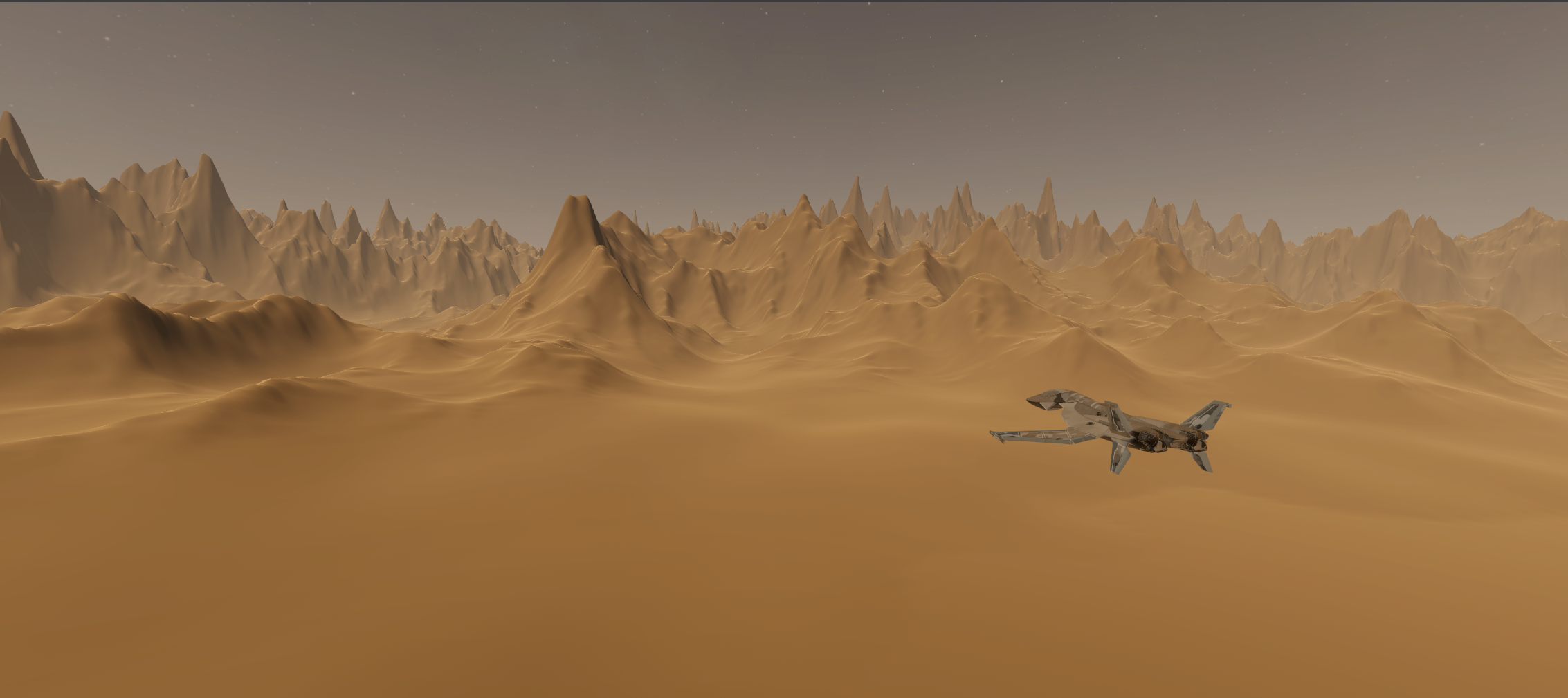
The pitch
ARCX flight is meant to be light to learn and deep to master. The control surface is small — mouse, WASD, Shift, Alt, Space — and the ceiling above it is high. There is a real difference between a pilot who’s flown for an hour and one who’s flown for a hundred, and we want that difference to be visible in the air.
The ancestor
Ace Online — released as Space Cowboy Online in May 2006 — is the direct lineage. If you played it, your fingers already know ARCX. Mouse moves the ship. The crosshair is the nose. Where you point, the ship flies. A and D strafe sideways. W cruises, S brakes. Space is boost. It’s the layout that made Ace’s dogfights feel the way they did, and a lot of us never let it go. We didn’t either.
What we kept faithful, on purpose:
- Mouse-as-joystick. No keybind to roll. The ship handles its own banking when you turn.
- Vertical combat. You fight in three dimensions from the first second, not on a flat ring.
- Strafe as a real weapon. Lateral thrusters are first-class, not a side gimmick.
- Throttle is automatic. The ship holds cruise on its own; you brake with S and boost with Space. The middle is the game’s problem, not yours.
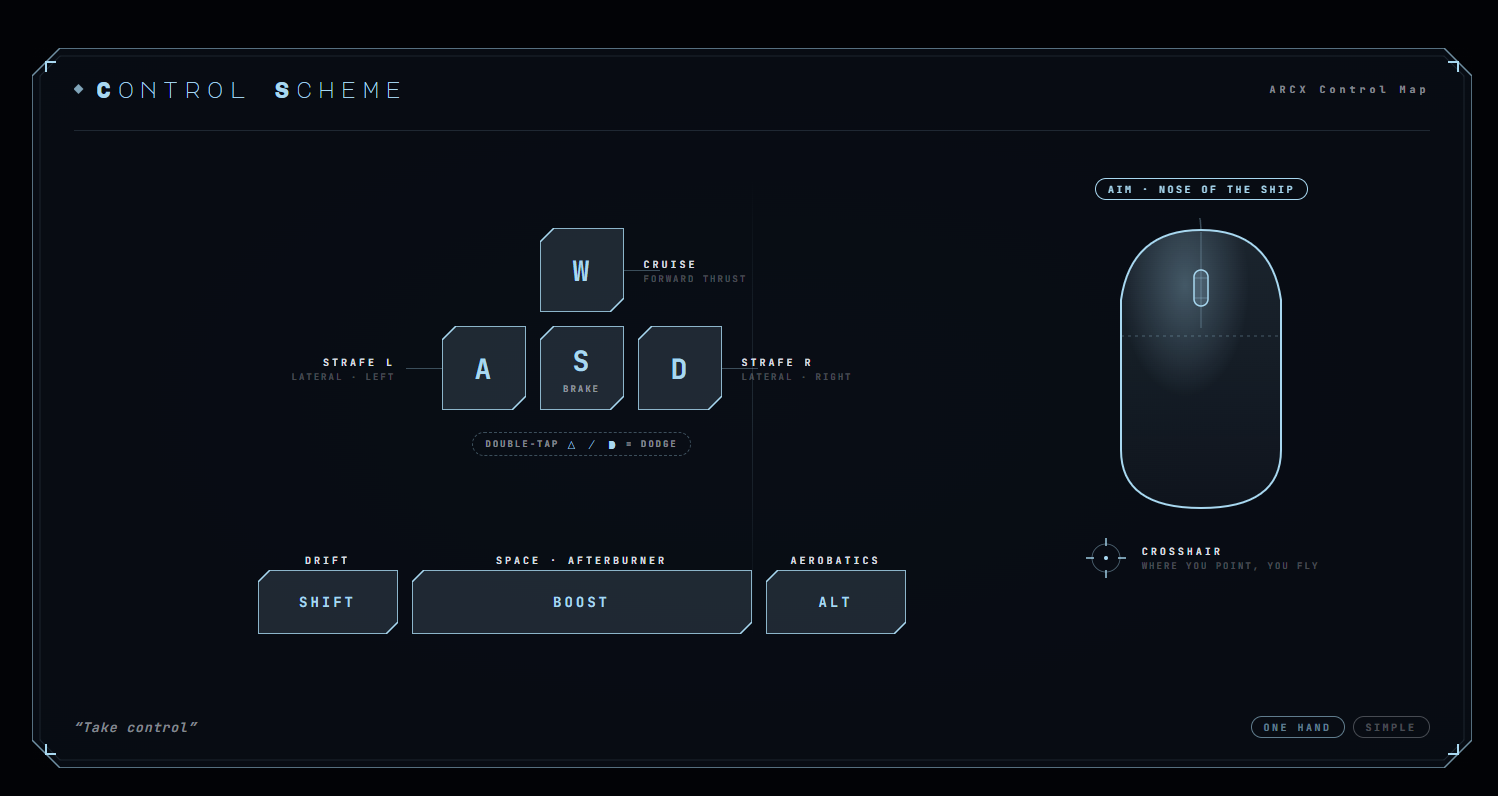
That last one is the small thing that lets new players actually fly. Most flight games hand you a throttle axis and expect you to manage it. ARCX manages it for you so you can spend your attention on aim, position, and timing — the things that decide fights.
One side note worth marking: this dispatch goes live twenty years to the day after Ace Online’s first release. Wasn’t planned. Felt right to point at on the way past.
What we changed
Where ARCX departs from Ace, it does so deliberately, in one direction: away from ability-triggered movement, toward physical skill.
In Ace, the hardest moves were button presses. Need to flip your gear around and fire on a pursuer? Press the ability. The game rotated you for you. That was the right call for a 2006 MMO running on the hardware of the time, but it meant the highest skill cap was timing-and-cooldown management, not flying. Twenty years on, we want the ceiling to be what your hands can do with the ship, not how well you sequence canned moves.
So we added the systems that make that possible.
Stall physics. If you slow down too far — under your engine’s minimum flight speed — the ship loses grip on the air. Lift collapses. The nose starts following gravity instead of your mouse. You have to recover. It punishes the wrong kind of slow flying and rewards energy management. Braking has a real consequence now, not just a speed change.
Drift. Hold Left Shift and the ship breaks the link between where the nose points and where it’s flying. Your velocity keeps going one way; the nose swings somewhere else. Turn rates roughly double inside drift, gravity hands off, and the camera tilts to a blended angle so you can still see your line. It costs RCS fuel and doesn’t refill while you’re in it, so it’s a tool, not a default. It’s also how you rotate the ship to fire on something behind you — manually, with your own input, not through a canned ability. That’s the lineage shift in one move.
Aerobatics. Hold Left Alt and the ship’s rotation latches to where your mouse is looking instead of where the body is pointing. Loops, split-S maneuvers, anything that crosses straight up or straight down — all of it works without the mouse axes flipping on you at the vertical. No fuel cost. It’s the “I want to do that thing” button, and you’re the one doing it.
Dodge. Double-tap A or D. The ship does a barrel roll in that direction with a brief window of invulnerability. Same idea as Ace’s sidesteps, made physical.
The flight stack runs on the physics engine, not on your render framerate. The ship is simulated on a fixed physics tick — at 60 frames or at 144, the math underneath is the same. We layered that on Unity DOTS so every ship in a fight runs in parallel across every CPU core; the simulation behaves the same whether you’re alone in the air or in a swarm.
How open it is
The flight model is one ship’s physics, but the inputs to that physics come entirely from equipment. Engine, frame, armour, RCS thrusters — every component changes the actual numbers the simulation reads. Thrust. Strafe authority. Drag profile. Boost ceiling. Minimum flight speed.
The Razor in the video below is running a starter engine. Swap engines and the cruise number moves, the stall floor moves, the strafe gets stronger or weaker, the turn cap shifts. Two players in two builds are flying two different ships even if the chassis is the same. That’s the build depth we promised in the first dispatch — it shows up here, in the air, not just on the stat screen.

Why this is a step up
Drift and aerobatics aren’t features-on-top-of-a-flight-model. They are the model.
Most flight games — even ones I love — have one way to point the ship and one way to move it, and that’s the whole verb set. You bank, you pull, you go where the bank tells you. ARCX has three modes of motion at the same set of fingers, and you can run them in combination. Drift lets you turn in directions your wings can’t. Aerobatics lets you aim in directions your body isn’t pointing. Boost lets you commit. Stack them and the shapes you can carve through the sky are not the shapes a bank-and-pull pilot can make.
This is, honestly, a bigger jump than I’ve seen in any flight game I’ve played. And it isn’t gated behind a stat or a skill tree — the buttons are the same on minute one and minute ten thousand. What changes is what the pilot does with them. A player who develops a real feel for these systems, and a real sense of when each one is worth its cost, can dominate the air.
The video
Some honest disclosure before you press play.
- This is early footage. We’re showing it because we’d rather you watch the work happen than wait for everything to be perfect. It’s not usual to share a build this raw — we’re choosing to.
- Engine flames and thruster VFX are not in this capture. They exist in the game; they weren’t in this build. We’ll share captures with them as soon as we can.
- The Razor in this clip is tuned a bit hot. I think it’s faster than it should be at the starter tier and it’s going to be tweaked. So is the rest of the model.
- The camera is our cinematic tool, not the gameplay camera. This is us watching the ship fly from outside, not a player’s view from the seat. We built the tool specifically to capture footage like this — it’s a separate system from the in-game chase camera. Don’t read this as “here’s what the HUD will look like.” It’s not.
- Terrain is in active rebuild. Some of what’s on screen is one of the latest passes of an in-progress system. Subject to change like everything else.
- All of this is subject to change. Numbers, models, VFX, terrain, all of it.
That said: a swarm engagement, barrel rolls, aerobatic loops, drifts around mountain peaks. The flight system holding up under combat load, scored for once.
What’s working right now
Honest state, same as every dispatch.
Working: Mouse aim, strafe, brake, boost, stall, drift, aerobatics, dodge, bank spring, the chase camera. Throttle automation. RCS fuel pool. Engine swaps that re-tune the whole model. The cinematic camera tool you just watched the clip through.
Not yet: Combat feel is still being wired in on top of this layer — weapons, damage, lock-on. The ship flies; the guns are arriving. Dodge is going through one more polish pass. Stall recovery feel is tuned globally; a per-chassis pass comes later. Engine and weapon VFX are in the game but weren’t captured in this clip — that’s coming.
Not for a while: Networking. Co-op flight comes after the single-player vertical slice is solid.
What’s next
Combat on top of this. The flight is the floor every other gameplay system stands on, and the floor is solid. The next dispatches will start showing what happens when you put weapons, enemies, and missions on top of it.
More on the air to come.
— Batuhan “Babbus” Yıldız · STRUX Games